


What if the greatest opportunity in workplace wellbeing isn’t supporting people when something goes wrong, but helping more people stay healthy, energised and fulfilled in the first place?
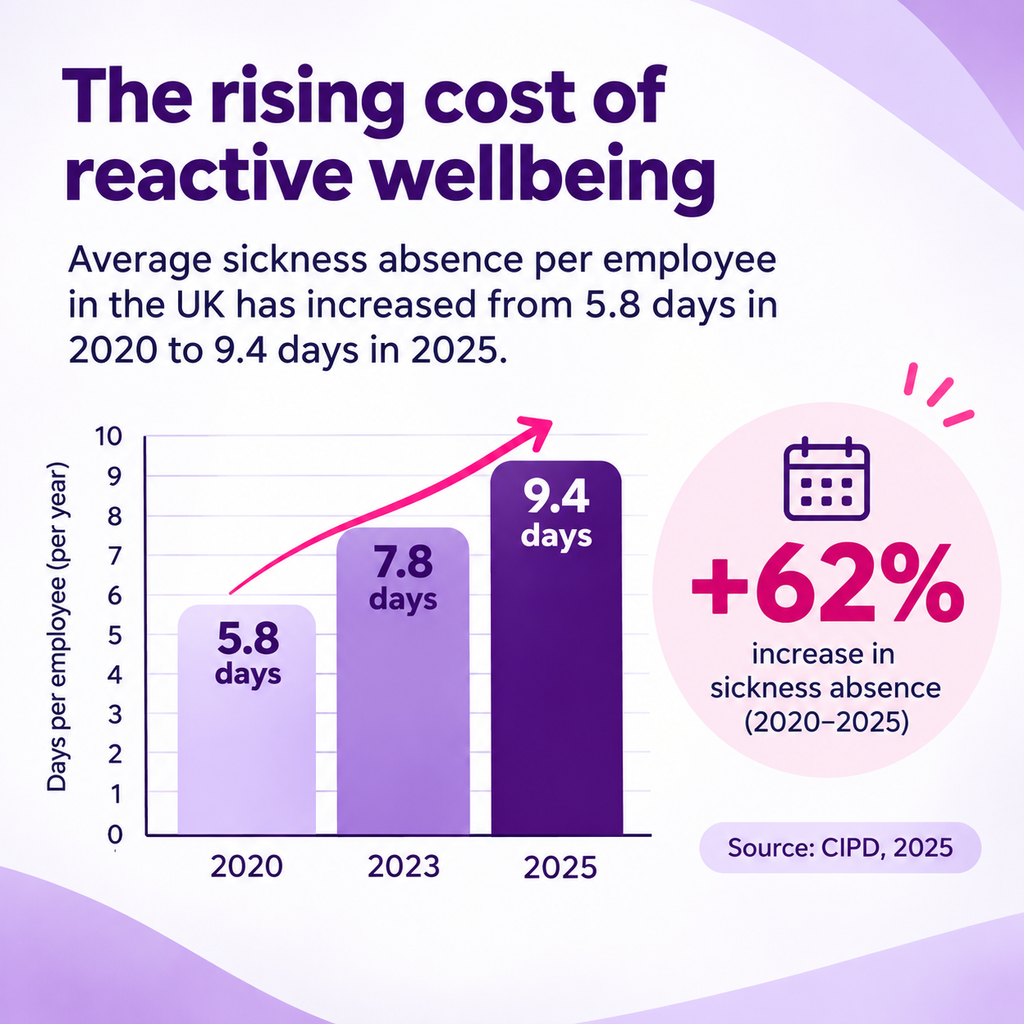
Across the UK, sickness absence is rising. According to the CIPD’s Health and Wellbeing at Work 2025 report, average employee sickness absence reached 9.4 days per year, compared with 7.8 days in 2023 and 5.8 days in its pre-pandemic survey.
That’s an increase of approximately 62% between the 2020 and 2025 reports.
At the same time, lifestyle-related health risks continue to present a significant global challenge. Physical inactivity, unhealthy diets, smoking and harmful alcohol consumption contribute to chronic diseases that affect millions of lives.
These challenges are complex. Not every illness is preventable, and the factors influencing people’s health extend far beyond the workplace.
But they raise an important question for employers.
Are we investing enough in helping people stay well, rather than concentrating our efforts on supporting them once their health has deteriorated?
At GoVida, we believe there’s an opportunity to rethink workplace wellbeing – moving beyond a primarily reactive approach towards one that makes positive health and wellbeing part of everyday life.
And the benefits could extend well beyond reducing sickness absence.
1. Is Our Approach to Employee Wellbeing Too Reactive?
Many organisations already provide valuable employee wellbeing support.
Employee Assistance Programmes (EAPs), occupational health services, counselling, mental health resources and return-to-work programmes can all play important roles in supporting employees through difficult periods.
These services are essential and should remain an important part of any comprehensive workplace wellbeing strategy.
However, much of this support becomes most visible when someone is already experiencing difficulties.
An employee is struggling with their mental health. Someone develops a long-term health condition. A colleague takes extended sickness absence.
The organisation responds by providing appropriate support.
But what happens before that point?
What are we doing to encourage healthier habits, stronger social connections, positive mental wellbeing and greater resilience throughout people’s everyday lives?
A reactive model can help people recover. A proactive approach aims to create more opportunities for people to stay well in the first place.
The two approaches are complementary, but the balance between them deserves greater attention.
2. The Workplace: An Opportunity to Positively Influence Health
For millions of adults, work occupies a substantial proportion of their waking week.
That makes the workplace an important setting for promoting health and wellbeing.
Unlike occasional health campaigns or appointments, the workplace provides regular opportunities to engage people, encourage positive behaviours and build supportive communities.
Think about the possibilities.
A team walking challenge can encourage colleagues to move more throughout the day.
A mindfulness activity can introduce someone to a simple technique for managing everyday pressures.
A creative challenge can encourage people to reconnect with hobbies they enjoy.
A volunteering initiative can strengthen community connections and provide a sense of contribution.
And a shared wellbeing challenge can bring colleagues together who might otherwise rarely interact.
None of these activities needs to feel clinical, complicated or burdensome.
The more enjoyable, inclusive and accessible wellbeing becomes, the greater the opportunity to make it part of everyday life.
This doesn’t mean employers should become responsible for every aspect of their employees’ health.
It means recognising that workplaces can be environments that positively influence people’s wellbeing, rather than simply places where wellbeing problems are managed.
Importantly, this also requires organisations to address working conditions themselves. Healthy habits cannot compensate for consistently excessive workloads, poor management or unsafe working environments.
3. The Growing Case for Preventative Health and Wellbeing
One of the strongest arguments for proactive wellbeing comes from the global burden of noncommunicable diseases.
According to the World Health Organization (WHO), noncommunicable diseases – including cardiovascular disease, cancer, diabetes and chronic respiratory conditions – accounted for approximately 75% of non-pandemic-related deaths worldwide in 2021.
Many of these conditions are influenced by modifiable risk factors, including:
- Physical inactivity
- Unhealthy diets
- Tobacco use
- Harmful alcohol consumption
- Air pollution and other environmental exposures
These factors do not explain every case of illness. Genetics, age, socioeconomic circumstances and access to healthcare also influence individual risk.
Nevertheless, substantial evidence shows that healthier behaviours can reduce the risk of developing a range of chronic conditions.
Physical inactivity: A growing global challenge
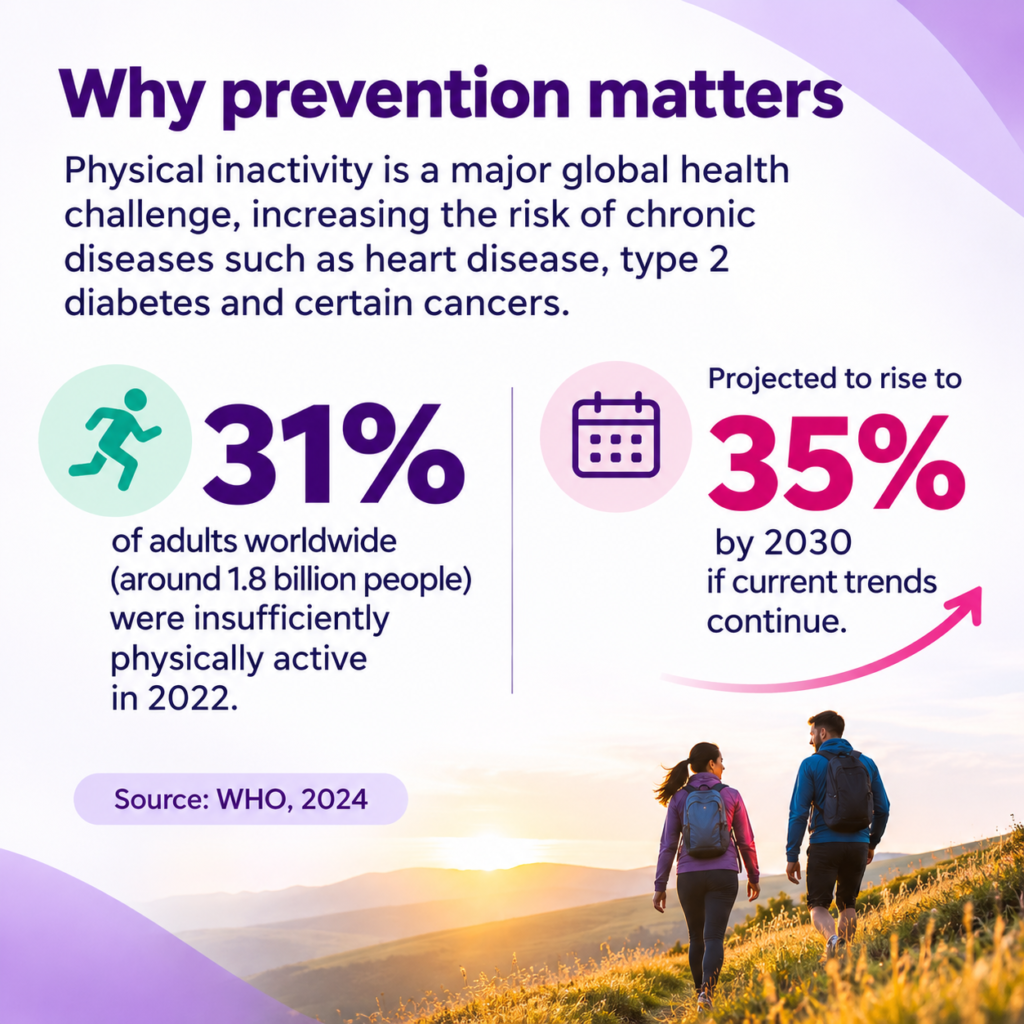
WHO estimates that approximately 1.8 billion adults worldwide – 31% of the adult population – were insufficiently physically active in 2022.
This represents an increase of around five percentage points since 2010.
And if current trends continue, the proportion of insufficiently active adults could reach approximately 35% by 2030.
Source: WHO -Nearly 1.8 Billion Adults at Risk from Insufficient Physical Activity, June 2024.
These figures are particularly concerning given the established relationship between regular physical activity and reduced risks of cardiovascular disease, type 2 diabetes and several cancers.
Physical activity also supports mental health, sleep quality and overall wellbeing.
Yet for many people, the challenge isn’t a lack of awareness that exercise is beneficial.
It’s finding the time, motivation, confidence and opportunity to make activity part of everyday life.
This is where employers have an opportunity to make a difference.
By encouraging movement, making participation enjoyable and creating shared goals, organisations can help employees take small, achievable steps towards healthier lifestyles.
And importantly, these opportunities should extend beyond physical activity alone.
Prevention is about more than exercise
While physical activity is important, a holistic approach to preventative wellbeing should also consider mental health, social connection, sleep, nutrition and the broader behaviours that influence how people feel.
For example, workplace initiatives can encourage employees to take regular breaks, spend time outdoors, participate in social activities or explore mindfulness and creative interests.
These activities have different evidence bases and should not be presented as equivalent medical interventions.
But together, they can help create more opportunities for people to engage positively with their health and wellbeing.
The objective isn’t to prevent every illness. It’s to help more people develop the habits and environments that support better health over time.
4. Wellbeing: A Foundation for Sustained Performance
The value of employee wellbeing extends far beyond preventing illness or reducing sickness absence.
Good physical and mental health can help people maintain the energy, concentration and resilience needed to perform consistently.
Supportive working environments can also create opportunities for greater engagement, collaboration and personal fulfilment.
What does the research tell us?
Gallup’s 2024 Q12 meta-analysis examined the relationship between employee engagement and business performance across more than 183,000 business and work units worldwide.
Comparing business units in the highest and lowest quartiles of employee engagement, researchers identified median differences of:
- 18% in sales productivity
- 23% in profitability
- 78% in absenteeism
Source: Gallup – Q12 Meta-Analysis and Employee Engagement Research.
These findings demonstrate a strong association between employee engagement and organisational outcomes.
They don’t establish that employee wellbeing programmes directly produce equivalent improvements, or that engagement and wellbeing are interchangeable.
However, they reinforce an important principle: how people experience their working lives is closely connected to organisational performance.
At GoVida, we believe positive wellbeing provides an important foundation for sustained performance.
Not by expecting people to work harder, but by helping create the conditions in which they have the health, energy, confidence and connection to perform at their best.
Because wellbeing shouldn’t simply be about reducing the downsides when things go wrong.
It should also be about helping people realise their potential.
The relationship between wellbeing, purpose and fulfilment
Wellbeing also has a relationship with purpose, identity and personal fulfilment.
A sense of purpose can positively influence our wellbeing, but the relationship can work both ways.
When our physical or mental wellbeing suffers, we may find it harder to maintain motivation, confidence and clarity about what matters to us.
Conversely, looking after ourselves can help create the energy and headspace to pursue our ambitions and interests.
Those interests won’t always relate to our careers.
They might involve family, friendships, creativity, sport, learning, volunteering or contributing to the community.
And what gives someone fulfilment can change considerably throughout their life.
Employers cannot define someone’s purpose, nor should they attempt to.
But they can recognise that employees are people with lives, interests and aspirations extending far beyond their job titles.
A truly holistic approach to employee wellbeing should reflect that.
5. Does Proactive Workplace Wellbeing Actually Work?
The case for encouraging healthier lifestyles is well established.
But does that mean workplace wellbeing programmes are automatically effective?
Not necessarily.
The way programmes are designed, delivered and experienced matters enormously.
A 2025 systematic review published in The Lancet Public Health examined 88 systematic reviews of workplace health promotion interventions.
It found that several approaches, including physical activity initiatives, mindfulness, stress management and multicomponent programmes, could improve certain health behaviours and outcomes.
However, effects were generally modest, and the quality of evidence varied.
Source: The Lancet Public Health – Workplace Health Promotion Research, 2025.
This is an important distinction for HR leaders.
Simply offering wellbeing initiatives doesn’t guarantee that employees will participate, develop healthier habits or experience lasting benefits.
Organisations need to think carefully about accessibility, motivation, engagement and how wellbeing fits into everyday working life.
The challenge of turning good intentions into lasting habits
Most people already understand that physical activity, healthy eating and looking after their mental wellbeing are important.
But knowing what is good for us doesn’t always make it easy to do.
Time pressures, competing priorities, confidence and motivation can all influence whether positive intentions translate into action.
That’s why successful proactive wellbeing strategies should focus not only on providing information, but also on making participation appealing and achievable.
Small actions, repeated consistently, can provide a more realistic starting point than expecting people to make dramatic lifestyle changes overnight.
And when those actions become enjoyable shared experiences, there may be opportunities to strengthen workplace relationships at the same time.
6. Making Positive Wellbeing Habits More Engaging
One of the challenges facing employers is how to encourage employees to participate in wellbeing activities consistently.
Traditional approaches often rely on information, resources or occasional awareness campaigns.
These can be valuable, but they don’t always translate into sustained participation.
This is where behavioural design and gamification can offer another approach.
What does the research say about gamification?
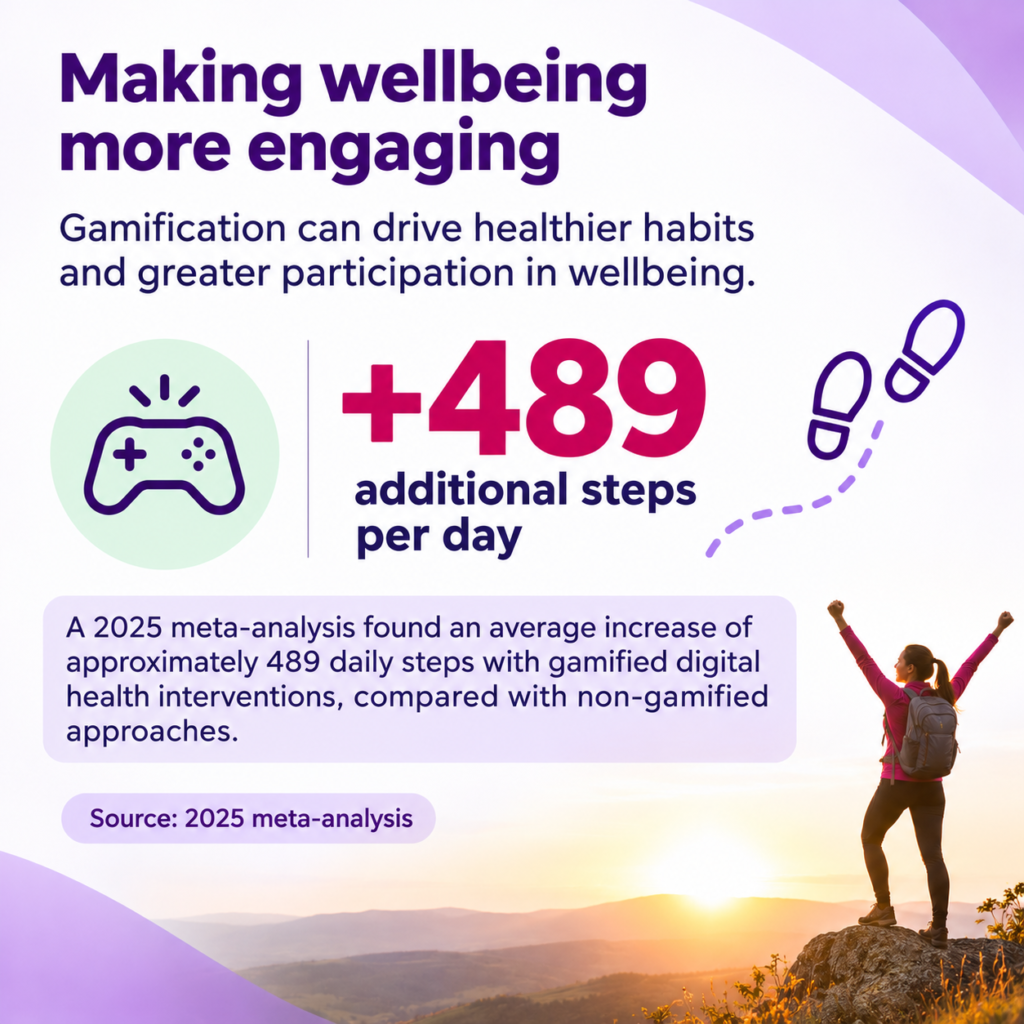
A 2025 systematic review and meta-analysis of randomised trials examined the effects of adding gamification to digital health interventions.
The findings suggested that gamified approaches could produce modest improvements in physical activity compared with non-gamified interventions.
Across the included studies, gamified interventions were associated with approximately 489 additional steps per day, on average.
Source: Systematic Review – Gamification and Physical Activity, 2025.
The findings don’t suggest that gamification is a complete solution, or that short-term changes automatically translate into lasting improvements in health.
But they support the potential value of making positive behaviours more engaging and rewarding.
Making wellbeing enjoyable and inclusive
At GoVida, we build on this principle by encouraging people to participate in a wide range of wellbeing activities through challenges, recognition, shared goals and rewards.
And importantly, wellbeing goes far beyond fitness.
For one person, a positive wellbeing activity might be going for a run.
For another, it could be practising mindfulness, painting, singing, gardening, volunteering or spending time connecting with others.
By recognising different interests, abilities and motivations, organisations can create more inclusive opportunities for participation.
The aim isn’t to turn wellbeing into another workplace obligation.
It’s to make looking after ourselves something positive, enjoyable and rewarding.
7. From Wellbeing Initiatives to a Culture of Wellbeing
A proactive wellbeing strategy should be more than a calendar of occasional events.
The opportunity is to create an environment where positive wellbeing becomes part of everyday working life.
For HR leaders, there are several important considerations.
Make wellbeing accessible to everyone
Not everyone enjoys running, cycling or going to the gym.
And employees will have different abilities, responsibilities, interests and circumstances.
A broader approach can encourage participation across a more diverse workforce.
Activities should be adaptable and inclusive, with alternatives available so employees aren’t disadvantaged by disability, health conditions or personal circumstances.
Encourage small, sustainable habits
Lasting improvements in wellbeing don’t necessarily begin with dramatic lifestyle changes.
They can begin with small, achievable actions repeated consistently.
Taking a lunchtime walk, practising mindfulness, making time for a creative hobby or reconnecting with colleagues can all contribute to a healthier routine.
The aim should be to make positive behaviours easier to adopt and sustain.
Create opportunities for social connection
Workplaces are communities.
Yet hybrid working, organisational structures and busy schedules can sometimes limit opportunities for meaningful interaction.
Shared wellbeing activities can help bridge those gaps.
Team challenges, collaborative goals and social initiatives can provide opportunities for colleagues to connect beyond their immediate responsibilities.
A walking challenge, for example, isn’t simply about accumulating steps.
It can encourage conversation, teamwork, friendly encouragement and shared achievement.
These experiences can contribute to a more connected workplace culture.
Support wellbeing beyond the working day
Employees don’t stop being people when they leave work.
Their relationships, interests, family responsibilities and personal aspirations all influence their wellbeing.
Employers can acknowledge this by encouraging activities that support employees’ lives outside work, rather than limiting wellbeing to what happens during office hours.
The objective isn’t to intrude into people’s personal lives.
It’s to recognise that supporting the whole person can be more meaningful than focusing exclusively on their working identity.
8. Building a Complete Employee Wellbeing Ecosystem
So, does a proactive approach mean organisations should move away from EAPs, occupational health or specialist support?
Absolutely not.
Employees will always experience illness, personal difficulties and periods when professional support is needed.
And employers have an important responsibility to provide appropriate help.
The opportunity is to create a more complete wellbeing ecosystem that combines three complementary elements.
Proactive wellbeing: Building positive habits and connections
This is the everyday layer of wellbeing.
Encouraging physical activity, mindfulness, creativity, social connection and other positive behaviours.
Creating opportunities for people to participate together.
Recognising achievements and helping employees develop sustainable habits.
This is where platforms such as GoVida can play a role in encouraging engagement and supporting a positive wellbeing culture.
Early intervention: Recognising when support is needed
Supportive managers, open communication, appropriate workplace adjustments and accessible resources can help employees address difficulties.
This requires a culture where people feel comfortable seeking support without fear of judgement.
It also requires employers to recognise and address organisational factors that can negatively affect health, including unreasonable workloads, poor management practices and unsafe working conditions.
Specialist support: Helping people when they need care
EAPs, counselling, occupational health, clinical services and rehabilitation programmes remain essential components of employee support.
These services should be accessible when needed and appropriately connected with the organisation’s wider wellbeing strategy.
The WHO’s guidance on mental health at work reinforces the importance of combining workplace risk prevention, mental health promotion and appropriate support for employees experiencing mental health conditions.
The future of employee wellbeing shouldn’t be a choice between prevention and treatment. It should bring both together.
9. How GoVida Supports Proactive Employee Wellbeing
At GoVida, our philosophy is simple.
Inspire people to develop positive wellbeing habits through enjoyable, engaging and rewarding experiences.
We believe wellbeing should be something people actively participate in, rather than simply a collection of services they turn to when something goes wrong.
That’s why the GoVida platform uses gamification, team challenges and rewards to encourage participation across a broad range of wellbeing activities.
These include physical activities such as walking, running and cycling, alongside mindfulness, creative hobbies, volunteering and other activities that support a holistic approach to wellbeing.
Employees can earn points for participating in positive activities, with opportunities to redeem rewards or support charitable causes.
Organisations can also bring teams together through themed challenges, shared goals and wellbeing experiences.
More than physical activity
One of the important distinctions in GoVida’s approach is recognising that wellbeing doesn’t begin and end with exercise.
Movement matters, but so do creativity, connection, mindfulness and personal fulfilment.
Someone who doesn’t enjoy traditional fitness activities should still have opportunities to participate in workplace wellbeing.
By broadening the range of recognised activities, GoVida aims to make wellbeing more accessible and inclusive.
Whether someone is taking their first steps towards becoming more active, rediscovering a creative interest or volunteering in their community, the goal is to encourage positive experiences that contribute to their overall wellbeing.
Bringing people together through wellbeing
We also believe workplaces have an opportunity to create meaningful connections through shared wellbeing experiences.
Team challenges and collaborative activities can provide a reason for colleagues to interact, encourage one another and celebrate achievements together.
This is particularly relevant for organisations with dispersed teams, multiple locations or hybrid working arrangements.
The intention isn’t simply to encourage individual activity.
It’s to help create a culture where wellbeing becomes something people can enjoy together.
Complementing existing support services
GoVida isn’t designed to replace EAPs, occupational health or specialist care.
Instead, it provides a proactive engagement and culture-building component within an organisation’s wider wellbeing strategy.
Professional support remains available when employees need it.
Meanwhile, everyday wellbeing activities create opportunities for people to look after themselves, connect with others and develop positive habits.
Together, these approaches can provide a more rounded employee wellbeing experience.
10. What Should HR Leaders Do Next?
For HR leaders reviewing their wellbeing strategy, the starting point may be to ask a different set of questions.
Not simply:
What support do we offer when employees are struggling?
But also:
What are we doing every day to help our people stay well?
Here are five areas worth considering.
1. Review the balance between reactive and proactive support.
Are resources concentrated on responding to problems, or are there meaningful opportunities for employees to develop positive wellbeing habits?
2. Understand the barriers to participation.
Do wellbeing activities appeal to employees with different interests, abilities and circumstances? Are workload, scheduling or accessibility preventing people from taking part?
3. Create more opportunities for connection.
Can wellbeing activities bring colleagues together across teams, departments and locations?
4. Make wellbeing part of the culture.
Are leaders supporting healthy working practices? Do employees feel encouraged to look after themselves without guilt or judgement?
5. Measure meaningful outcomes.
Participation rates can provide useful information, but they shouldn’t be the only measure of success.
Employee feedback, sustained engagement, wellbeing indicators and absence trends can all help organisations understand whether their approach is making a difference.
Measures should be proportionate, privacy-conscious and interpreted carefully. Changes in absence or performance cannot automatically be attributed to a wellbeing initiative.
Ultimately, the goal should be to create an environment where positive wellbeing is encouraged consistently, rather than relying solely on occasional campaigns or reactive services.
Conclusion: From Managing Illness to Inspiring Wellbeing
The growing challenges associated with employee health deserve serious attention.
But workplace wellbeing shouldn’t be defined solely by sickness absence, stress or the cost of poor health.
There is a much more positive opportunity.
To create workplaces that actively encourage healthier habits, stronger relationships, greater fulfilment and sustained performance.
That doesn’t mean turning the workplace into a GP practice.
It means recognising that organisations can positively influence wellbeing through the experiences, environments and opportunities they create.
It also means making wellbeing something people enjoy participating in, rather than something they only think about when they’re struggling.
At GoVida, we believe that when people feel healthier, happier, connected and energised, they are better placed to thrive – at work and in life.
Because the future of workplace wellbeing isn’t simply about helping people recover. It’s about inspiring more people to live well.
Related Health & Wellbeing Blogs

Could Your Employees’ Fitness Be Your Competitive Advantage?
Could employee fitness be an overlooked competitive advantage? Explore the science linking exercise with energy, focus and work performance – and how employers can help colleagues become more active.
Read this blog
Your People Drive Your Performance. Is Wellbeing a Priority in Your 2027 Business Plan?
Your people drive your performance. As organisations plan for 2027, discover why employee wellbeing, engagement and human connection should be central to business success – and how healthier habits, stronger relationships and a positive workplace culture can help people and organisations thrive.
Read this blog
Workplace Mental Health: Are We Asking the Right Questions?
Mental health is one of the leading causes of long-term sickness absence, but are employers asking the right questions? We explore the rise in workplace mental health challenges, the difference between awareness and understanding, and how HR professionals can take more meaningful action to support their people.
Read this blog