


You invest in your people’s skills and knowledge. Could supporting their fitness unlock more energy, sharper focus and better performance at work?
Businesses invest considerable time and money in helping people perform. Recruitment, training, technology and leadership development all receive attention.
But how much thought goes into the energy people bring to their working day?
Their ability to concentrate. How rested they feel. Their mood when a difficult conversation arises. Whether they reach the afternoon feeling engaged or exhausted.
Research into exercise and work performance links physical activity with greater energy, sharper focus and higher leadership ratings.
Could helping your employees become more active be an overlooked competitive advantage?
What working with elite performers taught me
In my previous career in physiotherapy and rehabilitation, I worked with hundreds of people from all walks of life. I was also fortunate to work with elite athletes, including Champions League and Premier League winners, three England captains, a Scotland captain and Ashes winners.
Some went on to coach or manage their national teams. Others built highly successful careers in the media.
I witnessed first-hand the dedication that went into preparing to perform. Training and recovery received deliberate attention. Much of the work happened away from the moments the public saw.
I recognise the difference in my own life, too. When I’m fit and regularly active, I feel happier, sharper, more confident and more energetic. Those benefits reach into my working day.
That experience has shaped how I think about employee wellbeing: how can we help more people feel well enough to do their best work?
The research provides some useful answers.
Exercise and work performance: what does the research show?
A study involving 201 employees across three workplaces compared their experiences on days when they exercised with days when they did not.
Employees rated their performance more highly on exercise days across measures covering mental and interpersonal demands, output and time management. Their mood improved after exercise, and changes in mood were closely linked with the improvements in reported performance. www.leedsbeckett.ac.uk
The participants already used workplace exercise facilities, chose their exercise days and rated their own performance. The findings therefore need that context. Nevertheless, they suggest that the benefits people feel after activity can extend into their working day.
More recent research has examined what happens the following day.
Two studies published in Personnel Psychology tracked employees over 10 working days, drawing on employee reports, supervisor reports and objective data. Daily physical activity was associated with better sleep quality, greater vigour and improved task focus. Increased task focus helped explain the relationship between activity and better task performance the next day. onlinelibrary.wiley.com
These were observational studies, so they identify relationships rather than establish cause and effect. They do, however, offer a plausible explanation for an experience many people recognise: being active can leave us feeling better prepared for work.
The connection between exercise and leadership
The evidence also reaches into senior leadership.
Researchers examined data from more than 600 senior executives, comparing exercise habits with two leadership assessment tools. These included feedback from bosses, peers and direct reports.
Executives who exercised regularly received significantly higher overall leadership ratings from observers than those who did not. doi.org
This does not prove that exercise creates better leaders. Health, personal organisation, motivation and access to resources could influence both activity and leadership.
It does raise a useful question for employers: are we giving enough attention to the habits that may support people in demanding roles?
More energy without an intensive training programme
Supporting an active workforce does not require everyone to train like an athlete.
Activity and fitness are related, but they are different. Activity is what we do; fitness describes capabilities such as aerobic capacity and strength. Some benefits of movement can appear before measurable fitness improves.
In a small randomised trial, 36 sedentary young adults experiencing persistent fatigue completed six weeks of low-intensity exercise, moderate-intensity exercise or a control condition.
Both exercise groups experienced improved energy. Low-intensity exercise produced the more favourable fatigue outcome, and changes in energy and fatigue were unrelated to changes in aerobic fitness. pubmed.ncbi.nlm.nih.gov
That is an encouraging finding for someone who feels too tired to start. A manageable increase in activity may be a useful first step.
There is also evidence for moving during the day. A controlled study of 30 sedentary adults compared prolonged sitting with either a single 30-minute morning walk or six five-minute walks spread across the day.
Both walking patterns improved perceived energy and vigour. Regular movement breaks also improved mood and reduced fatigue, including in the late afternoon. Cognitive test performance did not significantly differ between conditions. link.springer.com
For employers, this offers a practical opportunity: small movement breaks may help colleagues feel more energetic through the working day.
Sharper focus and clearer thinking
Many jobs depend on remembering information, managing attention, planning and making decisions. These make the relationship between exercise and cognition particularly relevant.
A 2025 umbrella review in the British Journal of Sports Medicine brought together 133 systematic reviews covering 2,724 randomised trials. It found small to moderate average improvements in general cognition, memory and executive function – the processes involved in planning, controlling responses and managing attention. Benefits were more modest when the analysis was restricted to higher-quality evidence. bjsm.bmj.com
There is scientific debate about the size and reliability of these effects. A 2023 review focused on healthy populations found that apparent cognitive benefits became negligible after correcting for publication bias. pubmed.ncbi.nlm.nih.gov
The balanced conclusion is that exercise can support cognitive function, while benefits vary across populations and studies.
For a business that depends on people thinking clearly, this is a credible reason to make activity part of the wellbeing conversation. It is not a basis for promising a fixed productivity increase.
Better sleep and recovery
The resources people bring to work are partly shaped by how well they recover between working days.
A 2025 review covering 86 randomised trials and 7,276 participants found improvements in sleep quality across several forms of exercise. These included aerobic exercise, resistance training, combined training, yoga and Pilates. link.springer.com
That gives colleagues different ways to participate. People can choose activities that fit their interests, abilities and circumstances.
Better sleep is valuable in its own right. Alongside the workplace research connecting activity with sleep quality and next-day task focus, it also offers one possible pathway through which exercise can support working life. onlinelibrary.wiley.com
A more positive working day
Feeling happier is one of the differences I notice most when I’m active.
Research supports a connection between physical activity and positive wellbeing. A meta-analysis involving healthy people found a small positive overall relationship, with a stronger connection to positive feelings than to broader life satisfaction. It included experimental and observational studies. pubmed.ncbi.nlm.nih.gov
A lunchtime walking trial provides a practical workplace example.
Fifty-six previously inactive employees were randomised to begin a walking programme immediately or after a delay. The programme involved three 30-minute lunchtime group walks each week for 10 weeks.
Walking improved aspects of enthusiasm, relaxation and nervousness at work, although results varied between analyses. pubmed.ncbi.nlm.nih.gov
A walk cannot resolve an excessive workload or poor management. It can be one accessible way to help people feel better during their day.
Stronger connections between colleagues
Shared activity can also create opportunities for people to connect beyond everyday tasks.
A cluster-randomised trial involving 200 female healthcare workers compared group exercise during working hours with exercise at home.
Exercising together at work improved social capital within teams—a measure relating to trust and cooperation—relative to home exercise. The study did not demonstrate a corresponding improvement in relationships with immediate managers. pubmed.ncbi.nlm.nih.gov
The distinction matters: this was evidence about participating together, rather than proof that individual fitness automatically improves relationships.
For employers, shared activities offer a practical opportunity to create encouragement, conversation and a sense of common purpose.
What could this mean for your business?
The evidence points towards benefits for energy, mood, sleep and aspects of focus. Some studies also measure work ability directly.
In a year-long randomised trial involving 387 office workers, a structured exercise programme improved reported work ability by 4% relative to a control group. The programme combined a weekly tailored exercise session during working hours with recommendations for activity outside work.
The main analysis did not find a significant reduction in sickness absence. pubmed.ncbi.nlm.nih.gov
Employers should be realistic about what these results establish. Individual studies cannot guarantee higher output or lower absence across every workforce.
They do provide a credible business case for supporting activity: helping people feel more energetic, focused and connected can contribute to the conditions for good performance.
The opportunity is to make those benefits accessible across the workforce.
How employers can turn the evidence into action
In elite sport, preparation and recovery receive deliberate attention. Employers can apply that principle by making wellbeing practical within everyday working life.
Make time for movement
Encourage movement breaks, protect lunch breaks and offer walking meetings where suitable.
Colleagues need opportunities they can realistically use. Meeting schedules, workloads and managers’ expectations should support the message.
Give people a choice
Include activities suited to different abilities, interests and starting points. Walking, cycling, swimming, strength training and adapted activities can all have a place.
Recognise achievable personal progress. Someone returning to activity should have a meaningful place alongside someone who already exercises regularly.
Make participation social
Shared challenges, group activities and collective goals give colleagues reasons to participate and encourage one another.
Provide options across locations and working patterns, including ways for people who prefer individual activities to contribute.
Involve leaders
Managers can demonstrate support by taking breaks, joining activities and making space for colleagues to participate.
Their involvement helps make wellbeing visible. It should accompany realistic workloads, good communication and supportive working practices.
Build a regular rhythm
Create opportunities throughout the year, with achievable goals, variety and recognition.
Listen to colleagues and review participation. Use what you learn to make the programme relevant to more people.
Where GoVida comes in
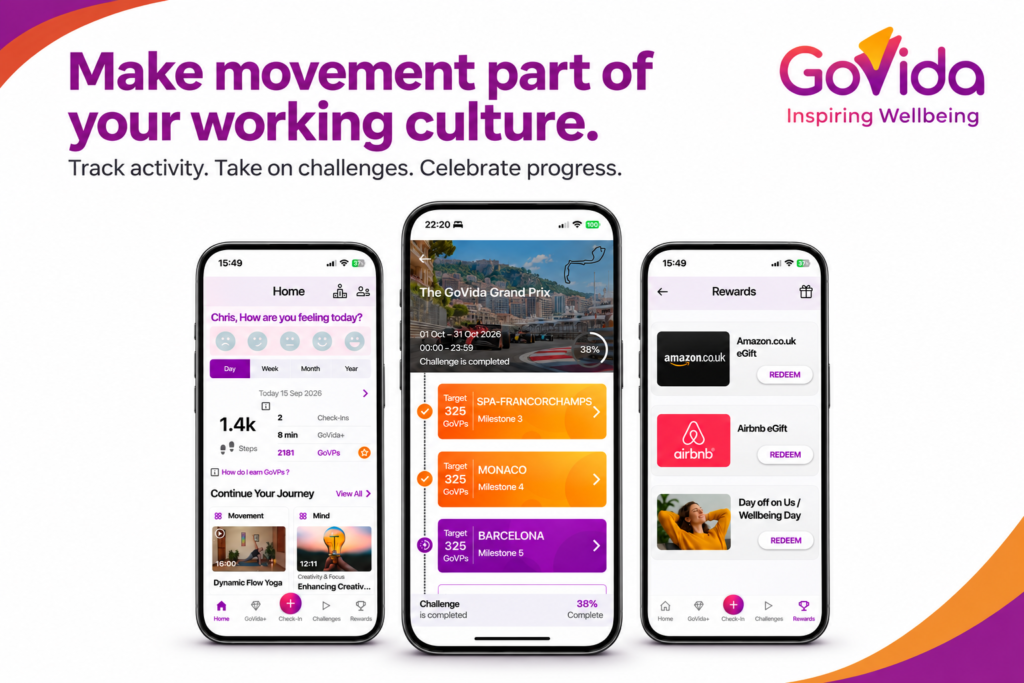
GoVida’s employee wellbeing platform gives employers a practical structure for putting these principles into action.
Through activity tracking, inclusive team challenges, wellbeing content and rewards, colleagues can find activities they enjoy, contribute towards shared goals and receive recognition for participating.
Leaders can take part alongside their teams. Employers can use aggregated engagement insights to understand participation and improve their programme.
GoVida provides the structure and encouragement. Leadership support and everyday working practices give people the opportunity to benefit.
My experience in rehabilitation, elite sport and my own life has shaped a simple belief: feeling well helps us prepare to do our best.
Could your employees’ fitness be your competitive advantage? The opportunity starts with helping more people feel energetic, focused and ready for their day.
Discover how GoVida can help you build a more active, connected workplace.
Related Health & Wellbeing Blogs

Your People Drive Your Performance. Is Wellbeing a Priority in Your 2027 Business Plan?
Your people drive your performance. As organisations plan for 2027, discover why employee wellbeing, engagement and human connection should be central to business success – and how healthier habits, stronger relationships and a positive workplace culture can help people and organisations thrive.
Read this blog
Is Employee Wellbeing Too Reactive? The Case for a Proactive Approach
Is employee wellbeing too reactive? Discover how a proactive approach can inspire healthier habits, stronger connections and happier, more energised teams. Explore why workplace wellbeing should go beyond preventing illness to helping people thrive, both at work and in life.
Read this blog
Workplace Mental Health: Are We Asking the Right Questions?
Mental health is one of the leading causes of long-term sickness absence, but are employers asking the right questions? We explore the rise in workplace mental health challenges, the difference between awareness and understanding, and how HR professionals can take more meaningful action to support their people.
Read this blog